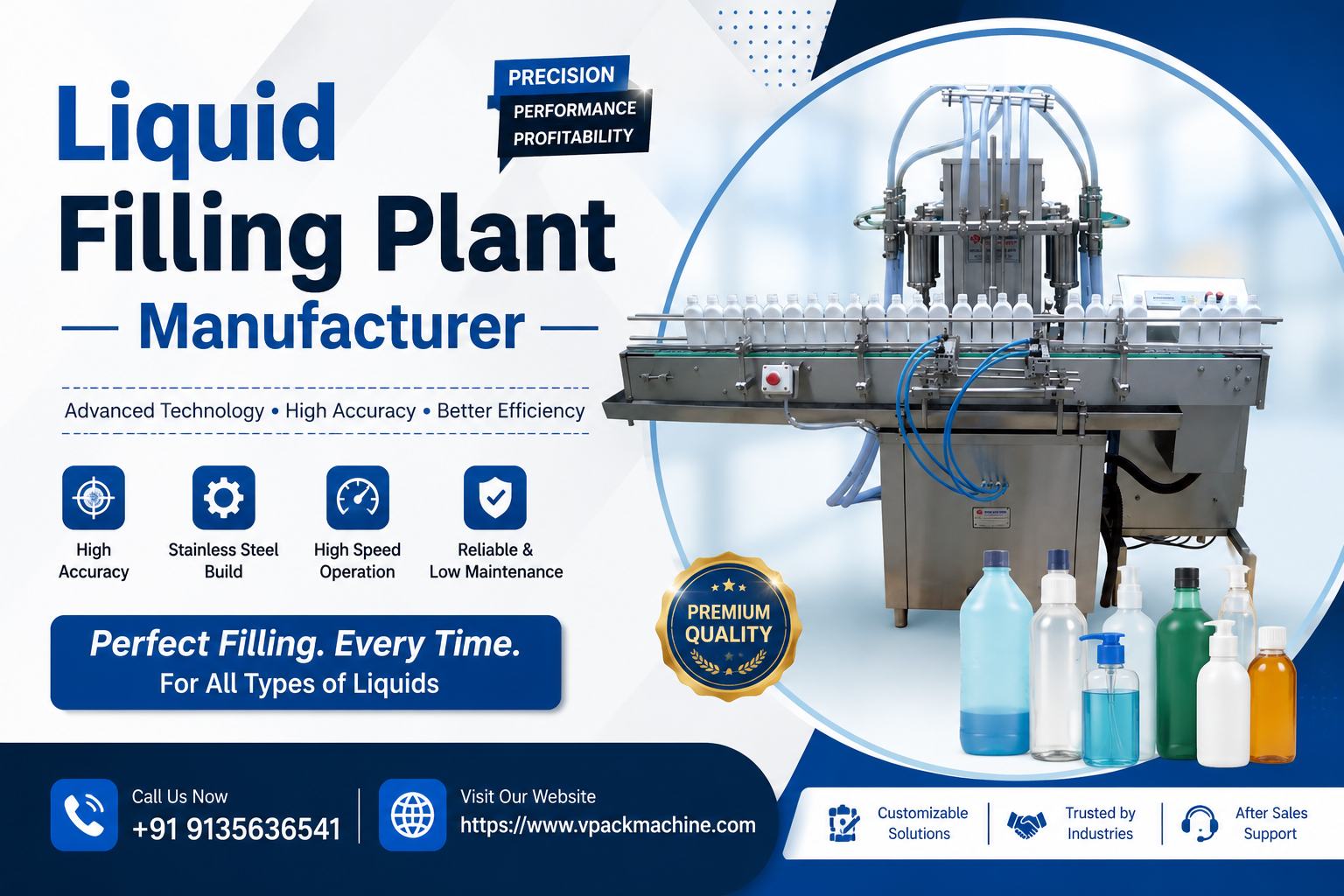
Imagine you’re running a growing business — maybe you make juice, medicines, oils, or cleaning products. Every day, your team manually fills hundreds of bottles. It’s slow. It’s messy. And you’re losing money every hour. Sound familiar? This is exactly the problem a good liquid filling plant manufacturer solves. If you are in Delhi or anywhere in India and looking for a reliable, affordable, and efficient liquid filling machine, you’ve come to the right place. In this guide, we’ll walk you through everything — how these machines work, what to look for when buying one, how different types compare, and why Vpack Machine, a leading name in Delhi, has become the go-to choice for businesses of all sizes. Let’s start from the very beginning — simple, clear, and no confusing. What Is a Liquid Filling Plant? A liquid filling plant is an industrial setup that automates the process of filling liquids into containers. It can handle thin liquids like water or thick ones like honey, shampoo, or syrup. These plants are used in industries like food and beverage, pharmaceuticals, cosmetics, chemicals, and agriculture. A complete liquid filling plant typically includes a filling machine, conveyor system, capping machine, labeling unit, and sometimes a sealing or coding unit — all working together in one smooth production line. Did You Know? The global liquid filling machinery market is growing rapidly through 2026, driven by rising demand from food, pharma, and personal care industries. Delhi alone has hundreds of manufacturers relying on automated filling solutions every day. How Does a Liquid Filling Machine Work? It’s simpler than you think. Here’s a basic step-by-step breakdown: Empty bottles or containers are placed on a conveyor belt The machine detects each container and moves it into the filling position A nozzle opens and fills the exact measured amount of liquid The container moves forward for capping or sealing Finally, labels are applied and the product is ready to ship The whole process takes just a few seconds per bottle — something that would take a human worker several minutes manually. What Are the Different Types of Liquid Filling Plants? Not every business needs the same machine. Here are the most common types you’ll find from any trusted liquid filling plant manufacturer in Delhi: Gravity Filling Machine — Best for thin, free-flowing liquids like water, juices, and alcohol Piston Filling Machine — Ideal for thick, viscous liquids like creams, pastes, and sauces Overflow Filling Machine — Used for foamy liquids and products in clear bottles for a clean, uniform look Peristaltic Pump Filling — Perfect for pharmaceutical and sensitive liquids requiring high hygiene Volumetric Filling Machine — Accurate filling based on volume, great for chemicals and oils Aseptic Filling Plant — Used in dairy and pharma for contamination-free sterile filling What Are the Key Benefits of a Liquid Filling Plant? This is probably the most important question. Why should your business invest in a liquid filling plant? Here’s the honest answer: Production Benefits Fill thousands of bottles per hour — far faster than any manual process Consistent fill levels every time — no overfilling or underfilling Reduce human errors significantly in the production line Machines work 24/7 without fatigue or breaks Handle multiple container sizes with quick changeover Business Benefits Lower long-term labor costs and higher profit margins Less product waste means more money saved each month Faster delivery to market gives you a competitive edge Better hygiene and quality control boosts brand reputation Higher customer satisfaction due to consistent product quality In short, a liquid filling plant doesn’t just speed up your work — it transforms your entire production process and helps your business grow faster and smarter. What Features Should You Look For in a Liquid Filling Machine? When talking to any liquid filling plant manufacturer, always ask about these key features: Filling Speed — Measured in bottles per minute (BPM). Choose based on your actual production needs Filling Accuracy — Look for ±0.5% or better accuracy to avoid wastage and underfilling Material (SS304 or SS316) — Stainless steel ensures hygiene and long-term durability PLC Control System — Makes it easy to program, monitor, and troubleshoot the machine No-Container No-Fill System — Stops filling if no bottle is detected — saves product and reduces waste Easy Cleaning (CIP) — Clean-in-place feature is essential for food and pharma industries Adjustable Nozzle Height — Allows the machine to work with different bottle sizes and shapes Anti-Drip Nozzles — Prevents messy spills and product loss during filling HMI Touchscreen Interface — Simple operator panel for quick adjustments and monitoring GMP Compliance — Mandatory if you’re in food, beverage, or pharmaceutical sector Manual vs. Semi-Automatic vs. Fully Automatic — Which Is Right for You? Feature Manual Semi-Automatic Fully Automatic Filling Speed 5–20 BPM 20–60 BPM 60–600+ BPM Investment Cost Very Low Moderate High (fast ROI) Labor Required High Medium Minimal Accuracy Low Good Excellent ±0.5% Best For Startups Growing Business Large Scale Hygiene Level Depends on worker Moderate Very High Maintenance Low Moderate Regular but Easy ROI Timeline Instant 6–12 months 12–24 months Our Recommendation: If you’re processing 500+ units per day, even a semi-automatic machine from a reliable liquid filling plant manufacturer in Delhi will pay for itself within months. Buying Guide — How to Choose the Right Liquid Filling Plant? Buying the wrong machine is expensive. Here’s a simple 5-step checklist to follow before you invest: Step 1 — Know Your Liquid Type Is your liquid thin or thick? Does it foam? Is it corrosive or food-grade? Every liquid has the right machine type. Always share the exact product details with the manufacturer before ordering. Step 2 — Know Your Production Volume How many bottles do you need to fill per hour or per day? This determines the speed (BPM) and whether you need a semi-auto or fully automatic system. Step 3 — Know Your Container Type Bottles, pouches, sachets, cans — each requires a different setup. Make sure the machine you choose is compatible with your